Mercedes-Benz (MBG.de): Stronger Reported Profit, Weaker Underlying Reality (Q3 2026 earning review)
Mercedes-Benz Q3 2026: reported profit rose but adjusted EBIT fell 15%. China weakness, margin pressure and valuation outlook for value investors.

Mercedes-Benz Group reported Q3 revenue of €30.698 billion, down 4.5% year on year. Reported EBIT rose sharply to €1.77 billion, but this was mainly because the prior-year quarter carried heavy restructuring and legal charges. Most importantly, adjusted EBIT fell 15% to €1.78 billion.
Mercedes-Benz Cars division is (still) having problems
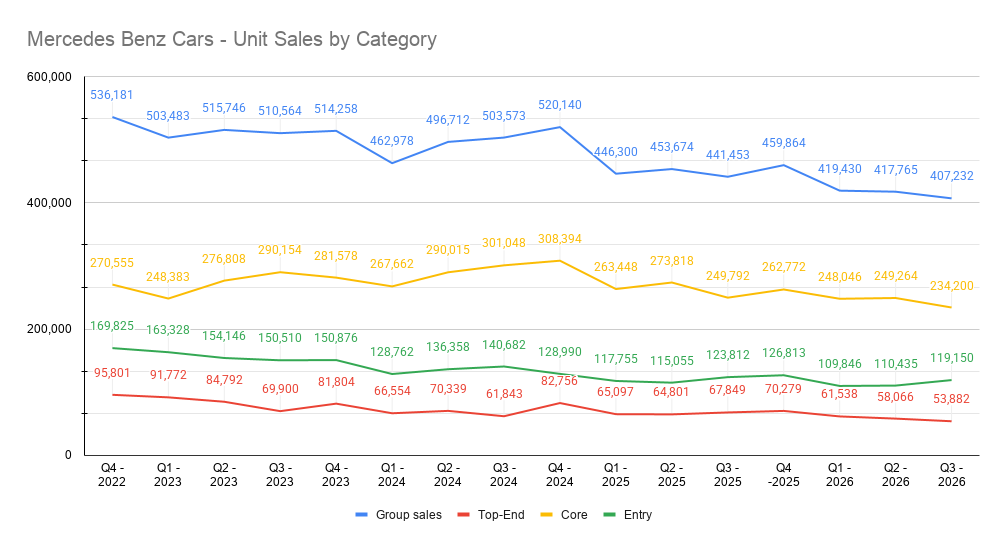
Sales in the Cars division fell 8% to 407,232 units - the lowest quarterly volume since I started covering the stock. For comparison, in Q3 2023 Mercedes-Benz sold 510,564 units, more than 100,000 more than today. Most of the decline occurred in China, where the company has been struggling from quarter to quarter, and I see no sign that this trend is slowing or stopping. In China, Mercedes-Benz sold just 86,000 cars, compared with around 195,000 in the same quarter three years ago.
There is another issue in this segment. Management cut full-year adjusted return-on-sales guidance to 2-3% (previously 3-5%). At the same time, free cash flow of the industrial business practically collapsed because of a sharp increase in inventory. Building inventories is a normal part of the business, but right now it looks more like a sign that demand is softer than production. It could also be preparation for a larger sales push, though we have not seen that yet.
Car sales in Germany, Europe and the USA are increasing, while battery-electric vehicles are setting records
As already noted, overall car sales are slowing, with the biggest decline in China at -31%. In Europe and the United States, sales rose 5% and 6% respectively. In other markets Mercedes-Benz reported flat or slightly lower sales that have remained broadly stable in recent years.
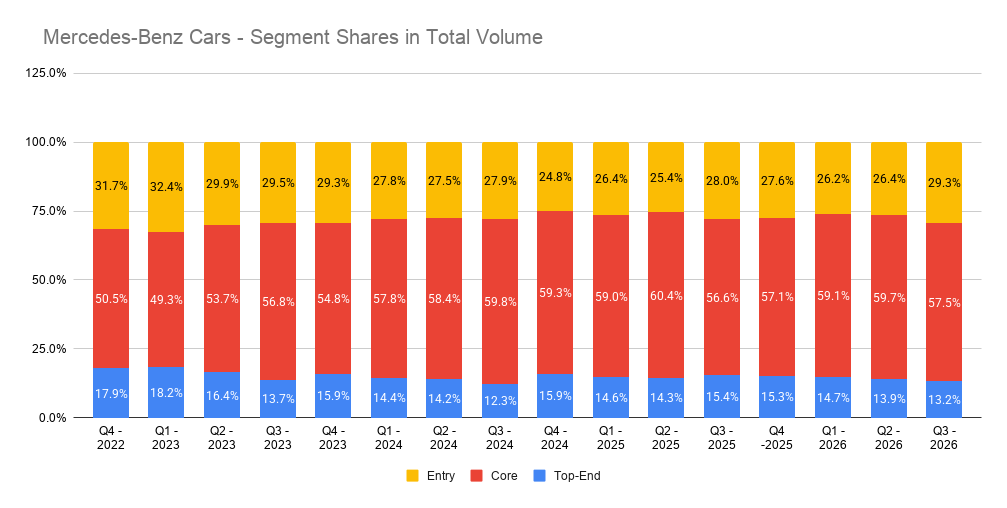
While the narrative from the new CEO is in some ways similar to that of Porsche’s management, the numbers show that Mercedes-Benz sales of top-end vehicles are slowing. That segment currently accounts for just over 13% of total unit sales, while core models make up a larger share of volume.
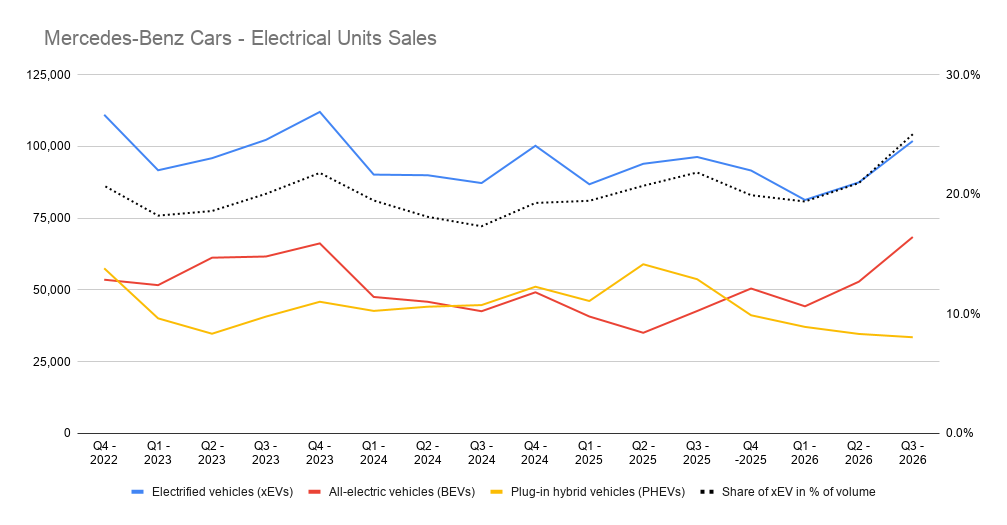
The biggest surprise is in the electric-vehicle segment. Electrified models (BEV and PHEV) accounted for 25% of newly sold cars, and the real progress is that customers are choosing full-electric vehicles more than plug-in hybrids. It is interesting that Mercedes-Benz has found a way to sell electric vehicles, while Porsche, as mentioned previously, has reduced its commitment to pure EVs.
What held the Group up?
Financial Services delivered strong results and the Vans division posted a solid adjusted return on sales of 9.4%. These two businesses provided a much-needed cushion. Net industrial liquidity remains healthy at €31 billion.
Structural risks are still present and not going anywhere
China remains structural, not cyclical. Mercedes-Benz is losing share in this large market to domestic competitors that are getting stronger, while the affordable-luxury segment is pushing middle-class buyers away from European brands.
Cars margin compression. At a 2.5% adjusted return on sales, the core business has limited buffer. Further volume weakness or pricing pressure would hit earnings hard.
Cash conversion. Inventory builds and weaker profitability can keep free cash flow down even if the balance sheet stays solid.
Product-cycle costs. New model launches help long-term, but they create near-term cost and margin pressure.
Broader industry headwinds. Tariffs, currency movements and raw-material costs remain ongoing variables.
What to Expect in 2027 and which dividend to expect from MBG
2027 should benefit from a fuller product pipeline and continued cost actions. The new S-Class, additional BEV models and efficiency measures can support mix and margins outside China. Vans and Financial Services are likely to remain reliable contributors.
However, a return to mid-cycle Cars margins (historically well above the current 2–3% range) still depends on China stabilising or the company successfully reducing its exposure. Management has not laid out a clear timetable for margin recovery. Until China volume and pricing improve, or until cost and capacity adjustments fully offset the lost volume, Group profit growth is likely to stay modest.
The brand moat is intact. Customer loyalty outside China remains strong and the product offensive is real. That is why the stock can still be interesting on further weakness.
On the dividend, Mercedes-Benz usually aims for an attractive payout (historically often around 40% to 50%). Current market estimates point to a dividend roughly in the €3.00–3.50 range, most probably toward the lower end. The company is also executing substantial buybacks, which from my perspective are even more interesting than the dividend, especially over a longer time frame.
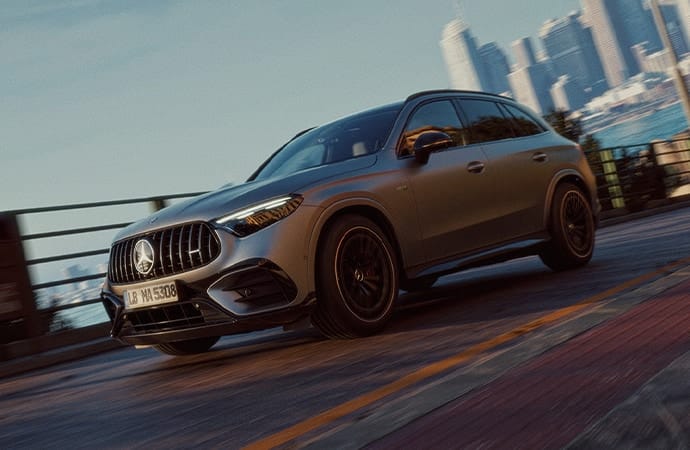
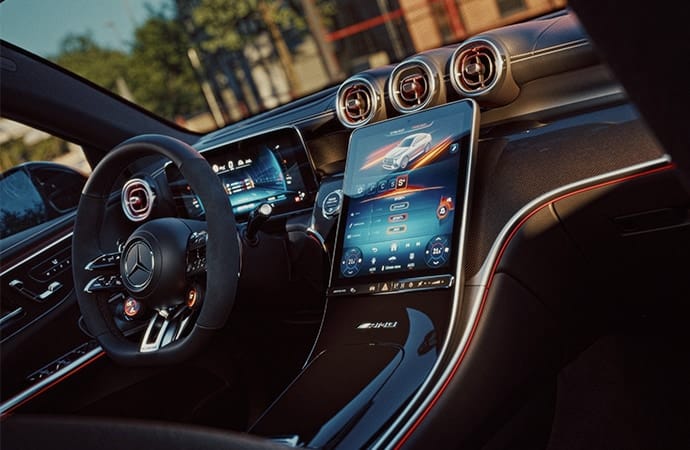
The 2027 Mercedes-AMG GLC
Current valuation and the path ahead
At roughly €40–41 the shares trade at a trailing P/E of about 7.1–7.2 and a forward P/E near 6.5, with a dividend yield of around 8.5% and a buyback yield of about 2% (combined shareholder yield above 10%). These multiples already price in prolonged Cars-margin weakness and little near-term help from China. On costs the company continues to make progress: fixed costs are roughly 25% below 2019 levels, productivity measures have been intensified since June (especially in Germany), the voluntary severance programme for indirect functions restarts in December, and Capex plus R&D at Cars fell 11% in the first nine months. Material-cost targets of around 8% versus 2024 remain in place, with deeper cuts and a shift to near-full local sourcing planned for China starting with the electric E-Class in the second half of 2027.
Management has been clear that China is both cyclical and structural. The premium segment has been declining for more than three years, the overall market contracted more than 20% this year, and intense competition from more than 100 players is compressing prices. Ola Källenius has said conditions are “deteriorating beyond what we had thought” and that “there is not a play where you put China aside,” while confirming a full review of the China model with a broader strategy due in 2027 and an explicit aim to reduce reliance on China as a profit pool. For me the current price looks very pushed down. Once we have clear proof that the Cars margin has stabilised and the China reset is working, the multiple should expand and I expect the shares to move into the €60 segment. Most probably this happens toward the end of 2027 or the beginning of 2028. Until then patience is still required, but the risk-reward at these levels is attractive for a long-term value investor.