Three Whys About NVIDIA After a Record Quarter: Why the Business Still Compounds, Why the Earnings Call Felt Wrong, and Why Leadership Is Wrong About Jensen
NVIDIA just delivered another record quarter that proves the AI infrastructure engine remains unstoppable. The real story is the leadership vacuum and what the board refused to discuss. Read why the numbers still matter more than the drama.


NVIDIA reported fiscal third-quarter 2027 results (ended October 25, 2026) that were excellent by almost any measure. Total revenue reached $115.8 billion, up 103% year-over-year. The main segment, Data Center, generated $107.6 billion, up 110% year-over-year. Diluted EPS came in at $2.70. The company also returned $28.1 billion to shareholders in the quarter.
In the same earnings release, NVIDIA guided for fourth-quarter revenue of approximately $130 billion and raised its fiscal 2028 revenue growth outlook to roughly 75%.
My focus going into this report was on gross margin. Many investors (including me) were concerned that margins would start coming under pressure as competition intensifies. Instead, the company reported gross margin slightly below 75%, which is right around its average.
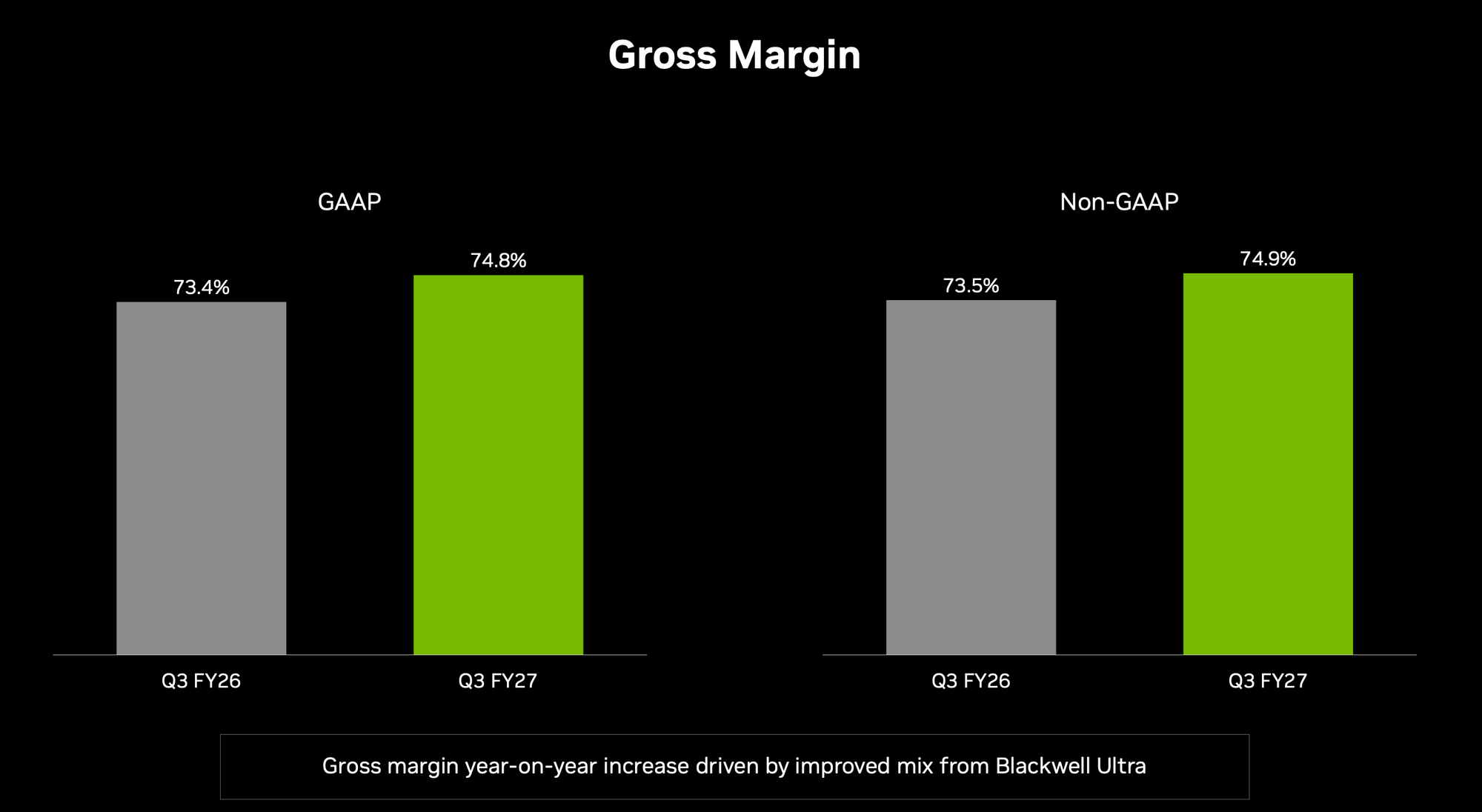
These results continue the trajectory I reviewed in my previous piece on Q3 2026.
The Leadership Issue
Okay, it is time to talk about the elephant in the room. Jensen resigned on November 12 amid reports of personal conduct inconsistent with the company’s standards, including alleged affairs (one reportedly involving a person suspected of being a Chinese intelligence asset). On the day of the earnings call he publicly stated he would be honored to return if the board determined it was in the best interest of shareholders, employees, the company, and America.
Five hours after that letter, board chair Harvey Jones opened the call by stating that the board unanimously accepted the resignation and “does not intend to reinstate Jensen as CEO.” He added that the company would not address or take any questions regarding him.
This is, in my view, the biggest problem with the call (I’ll get to the other later). Jensen is the founder, the face, the strategist, and an incredible leader. Speaking so strongly against him is never a good sign from management. Dismissing the founder in a single cold statement and then refusing further discussion feels like an attempt to erase the person who created the economic engine now generating these numbers.
Pretending that a leadership transition completed in days is a non-event, while the stock has already been under pressure from the scandal, is not the mark of transparent capital allocation or shareholder communication. (This is part of why we saw the price reverse after the market opened today.)
Another big mistake was the call itself, which was handled by Colette Kress. She is a highly capable executive with a long track record and more than a decade as NVIDIA’s CFO. Shareholders needed more from her than barely reading a script in the most boring way possible. Misspelling the name of a partner is never good. I really don’t understand why this part of the call was not prerecorded. In the end, such a capable person in such an important role was after the call perceived as an afterthought. That is a mistake.
Regarding a new CEO, it is hard to tell. According to the news and betting sites, Rene Haas is a strong candidate. On this blog we have talked about him as CEO of ARM. I would not be surprised if he comes to NVIDIA, but I would not be happy about it, because ARM would lose such a capable executive to a (semi) competitor.
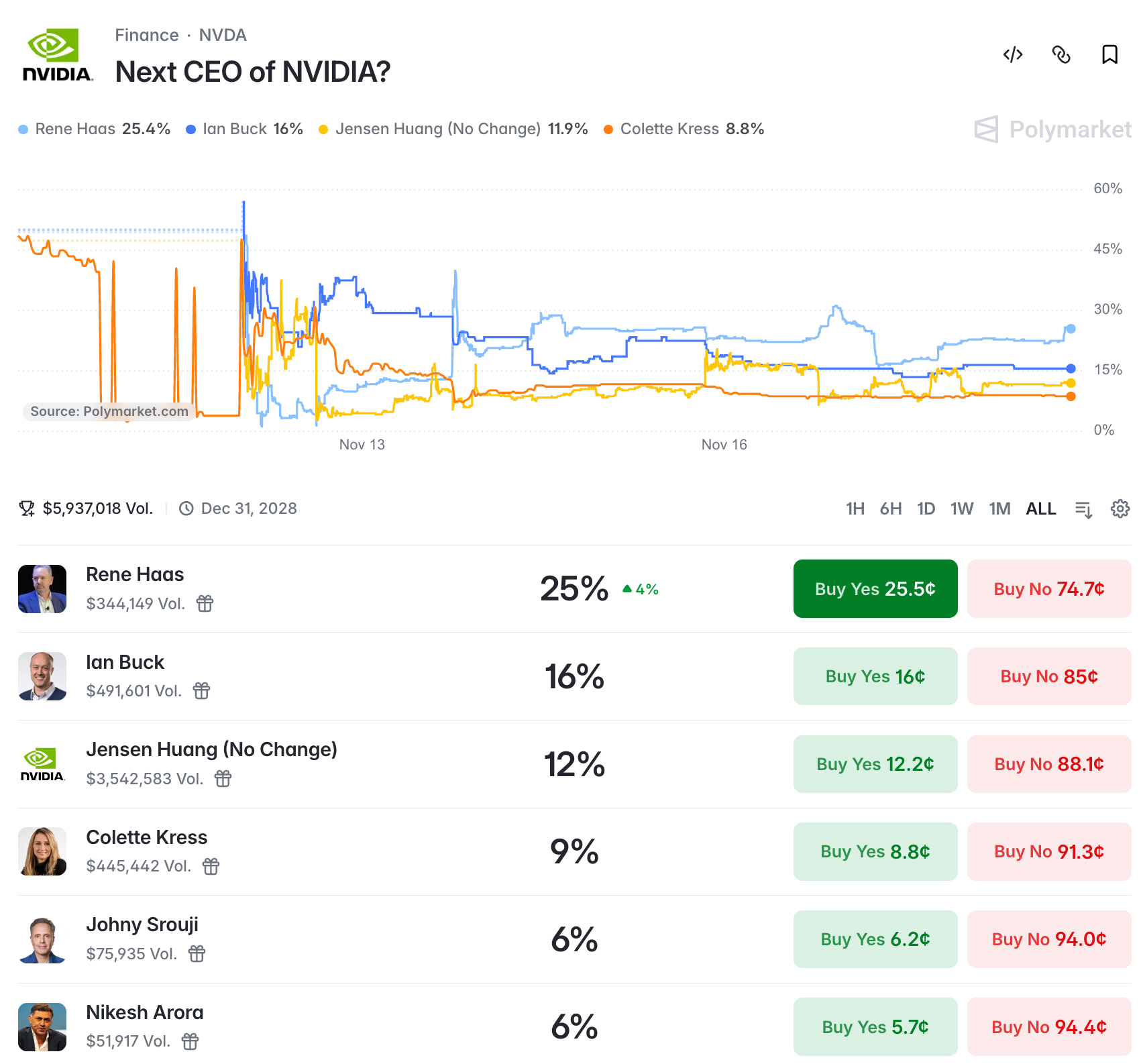
As for Jensen’s return: it would be great, but I think management will not allow it until they are in deep water. They have already taken many wrong steps, and if they bring him back quickly, a lot of explanation will be needed. Also, many of them would be forced to find another job.
Business Quality and Economic Moat
NVIDIA remains an exceptional business. It designs and sells the accelerated computing platforms that power the training and inference of large AI models, data-center infrastructure, networking, and increasingly physical AI and edge applications. The customer set is concentrated among hyperscalers, AI labs, sovereign buyers, and enterprises, yet demand has been broad enough to produce these growth rates.
The moat is wide and multi-layered: CUDA software ecosystem and developer lock-in, the full-stack platform (GPU + networking + software + systems), manufacturing and supply-chain scale, and the continuous product cadence (Blackwell to Vera Rubin). Switching costs are high. Competitors (AMD, custom ASICs from hyperscalers, and potential RISC-V or alternative architectures) exist and are gaining, but none has displaced NVIDIA’s lead in frontier training at scale.
Returns on capital remain extraordinary. Free-cash-flow conversion is high. Capital allocation has been aggressive on buybacks while still funding the roadmap. These are the characteristics of a high-quality compounder.
Risks that actually matter
The primary risks are no longer just cyclical AI spending or competitive ASICs. They now include:
- Leadership continuity and culture after the founder’s exit.
- Ongoing investigations (internal, SEC, congressional) and the national-security angle around China-related issues.
- Export controls and the explicit decision not to assume China Data Center compute revenue in guidance.
- Customer concentration and the possibility that frontier labs and hyperscalers accelerate custom silicon more aggressively than expected.
Conclusion: Is the Market Offering an Opportunity?
Even the world's largest publicly traded company is experiencing significant pushback from its all-time highs. With the stock trading around the low-to-mid $150s, its valuation is becoming increasingly interesting. Forward P/E has decreased and has now reached a level I would personally consider attractive.
So, why is the stock declining? A combination of company-specific events, industry-wide concerns, and shifting investor expectations has put significant pressure on the stock. Corrections of this magnitude cannot be reversed by one great earnings report. The market narrative needs to change, and that requires time, consistent execution, and evidence that long-term prospects remain intact.
Personally, I find this price level very attractive. At around $150, I believe the valuation and long-term potential is becoming increasingly interesting. I would consider this a buying opportunity and will most probably be looking to press that buy button over the coming days. Of course, this is my personal investment perspective, not financial advice. Do your own research, understand the risks, and make your investment decisions independently.