Is Netflix a Buy Now? Strengths, Risks, and the Value Investor Case Q3 2026
Netflix’s recent results show solid margins and cash generation, yet engagement and advertising progress remain under scrutiny. A value investor’s look at the risks, the new content leadership, and whether the current valuation offers a reasonable margin of safety.


In my earlier deep dive into Netflix’s Q4 2025 results and global monetisation strategy, I highlighted the combination of solid revenue growth, improving free cash flow, and early progress on advertising. That core formula still holds, but the latest quarter introduced more uncertainty around engagement trends and the pace of advertising product rollouts.
In Q3 2026 the company reported revenue of $12.87 billion, up roughly 12% year over year from $11.51 billion in the same quarter a year earlier. Operating margin expanded from 28.2% in Q3 2025 to 34.6%. Free cash flow for the quarter reached approximately $2.88 billion.
At the same time, Netflix maintained its leading position as a global paid streaming service, supported by a growing subscriber base and an expanding content library.
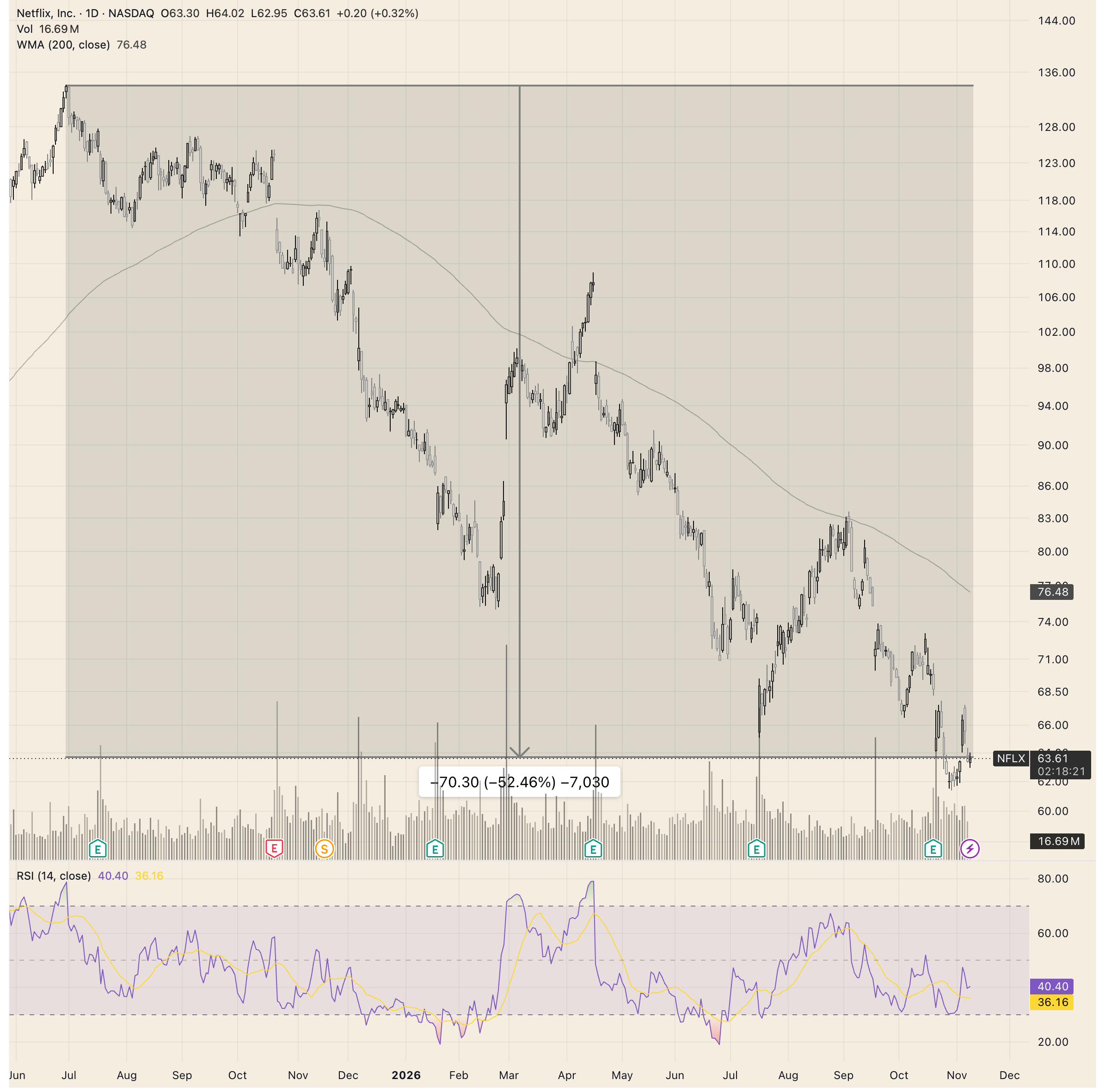
These results would normally support a move toward new all-time highs. Instead, the stock is trading more than 50% below its July 2025 peak.
Content quality and Advertising platform build-up
Content quality remains Netflix’s core product. Subscriber growth, retention, and pricing power all depend on the company consistently delivering shows and films that people actually want to watch. Many subscribers feel the quality of recent programming has declined, and it is common to hear that there has not been a major hit on the level of Squid Game for some time. While this has not yet shown up as a large drop in paid memberships in the financial results, it is still a risk the company needs to address.
In mid-October 2026 Netflix responded by replacing its Chief Content Officer. Bela Bajaria left the role and was succeeded by Peter Rice, a veteran executive with a strong track record at Disney and Fox. The change signals that management recognises slower engagement growth as a content problem and is taking direct responsibility for it something long-term investors (and netflix subscribers) generally want to see.
The ad-supported tier continues to expand and is scheduled to launch in additional markets in 2027. This is particularly relevant in lower-income countries, where it can be difficult to convert people from free or pirated content to a full-price subscription. With that in mind, the downward revision to the advertising revenue outlook highlights that building a full-funnel ad platform at scale is more complex than many initially expected.
I am not a strong supporter of Netflix moving into live events and sports. That said, the company appears to be using these events to help attract and retain subscribers. Rather than competing for expensive full-season rights, Netflix is focusing on high-impact tentpole events such as selected NFL games, boxing matches, and baseball-related events. This approach looks more disciplined than trying to fight established players for season-long packages that are costly and hard to monetise profitably.
Other Risks that Deserve Attention - Engagement and Competition
Growth in total viewing hours has slowed, and YouTube continues to take a larger share of overall attention, especially on connected TVs. That said, it is important to recognise that Netflix’s content is not the same as YouTube’s. Netflix focuses on professionally produced, high-quality series and films, which are significantly more expensive and difficult to create at scale, and it is hard to predict which titles will become major hits.
Disney, Amazon, and various regional players continue to invest heavily in their own streaming services. While they still represent a smaller share of total TV viewing time than Netflix, they are actively trying to gain ground whenever Netflix experiences a weaker content cycle.
Where the stock sits today and the long-term outlook
After the latest earnings release, investors did not receive strong confirmation that the company is navigating the current challenges smoothly. Advertising growth has been slower than expected, and content engagement metrics have been softer than in previous periods. At the same time, it is clear that management is actively looking for ways to address these issues.
One development that influenced sentiment earlier was Netflix’s attempted acquisition of Warner Bros Discovery’s studios and streaming assets (including HBO Max). The deal was announced in late 2025 but ultimately fell through in early 2026 when Warner Bros Discovery pursued an alternative transaction with Paramount Skydance. Netflix received a $2.8 billion termination fee. Some investors interpreted the bid as a signal that the company was becoming less confident in its ability to grow through original content alone and was instead looking to buy established libraries and franchises. Management has since reinforced a preference for organic growth, but the episode still left a mark on how parts of the market view Netflix’s content strategy.
Right now Netflix is trading around $65. At this level the forward P/E is roughly 17 and the trailing P/E is around 18.4. Both multiples sit below the company’s longer-term average. Operating income and operating margin continue to expand and currently stand at record levels. The company is also buying back shares at a rapid pace, which is a meaningful form of capital return given that it does not yet pay a dividend.
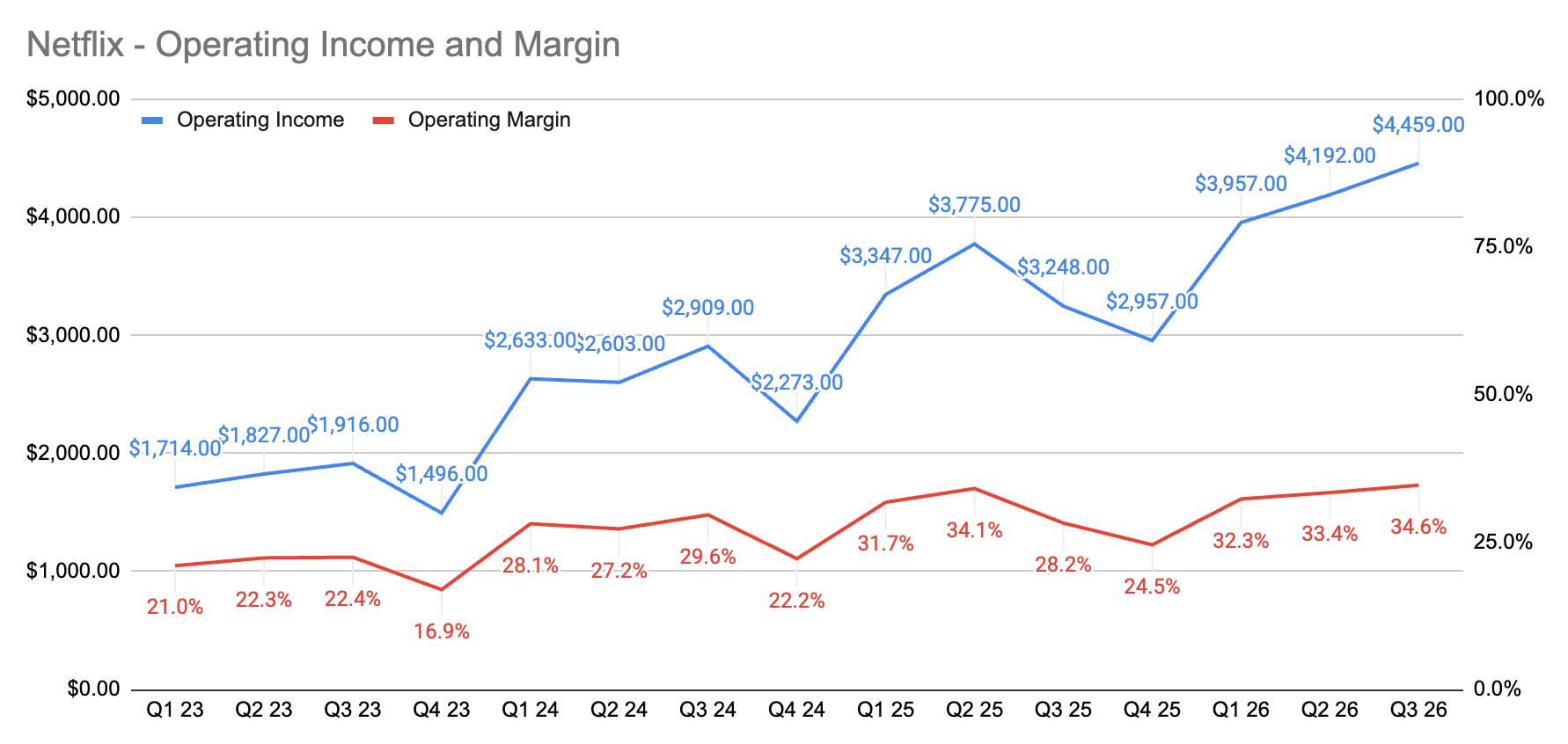
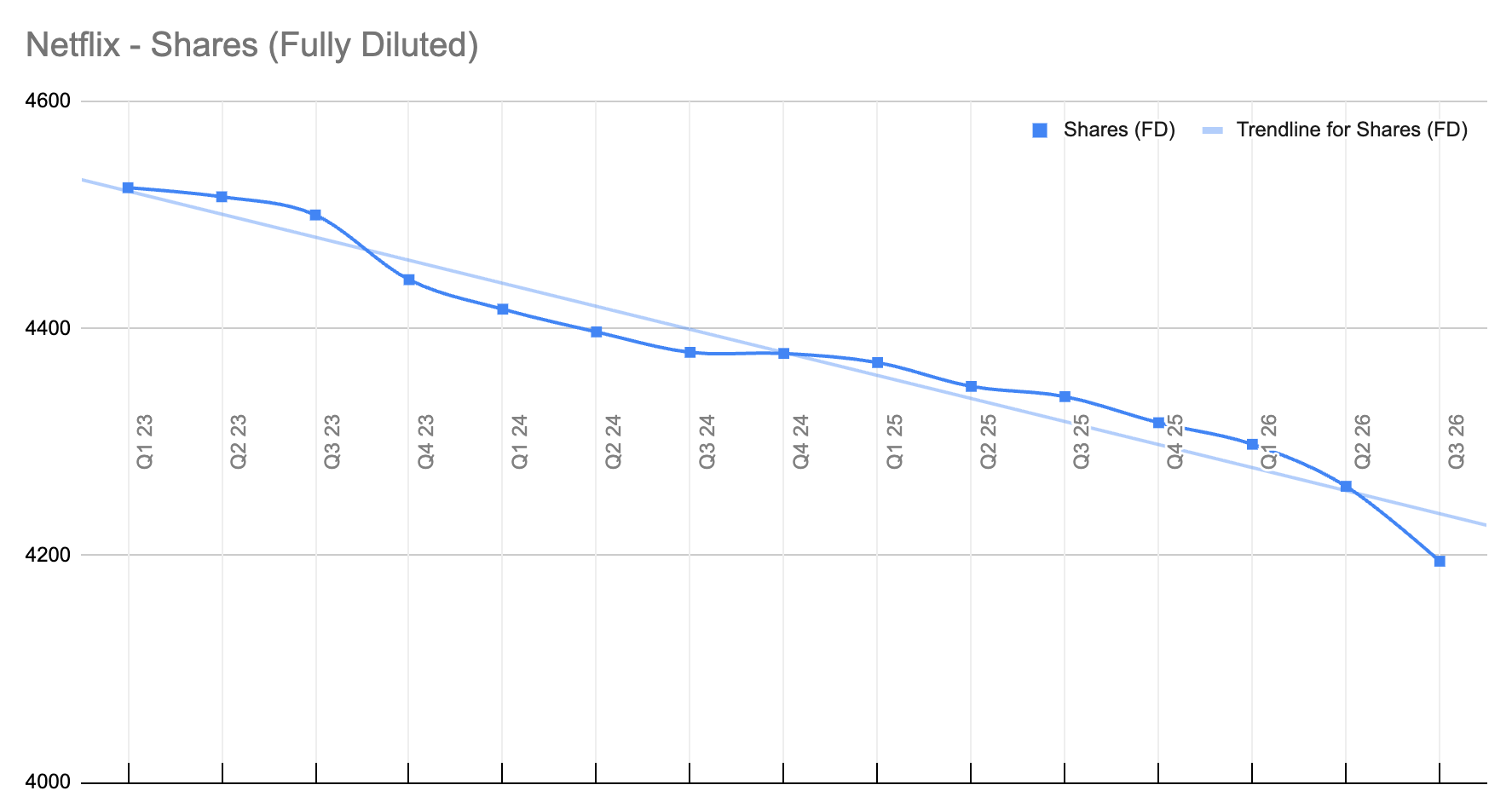
Netflix Operating Income, Operating Margin and number of shares Q3 2026 data: Netflix financial report
From my perspective, the current price represents an attractive entry point. The fundamentals look solid (though not exceptional), and we should have a clearer picture of the company’s direction over the next one or two quarters. Even modest evidence that engagement is stabilising or improving could help the stock move back toward the $100 area. On the other hand, if engagement continues to soften and the advertising business fails to accelerate, a move toward the mid-$50s remains possible.
Ultimately, this is still a company with a powerful brand, a meaningful economic moat, and a strong balance sheet. Those qualities matter more over a multi-year horizon than any single quarter’s engagement or advertising print.